#Post Title #Post Title #Post Title #Post Title #Post Title #Post Title
Thursday, September 27, 2012

IB Middle Years Program

International Baccalaureate Organization
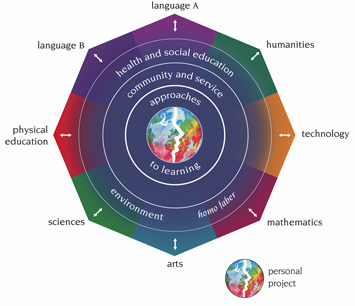
The International Baccalaureate Middle Years Program (IBMYP) is said to be a "whole school" Instructional Philosophy designed to provide all students with a challenging and enriching curriculum that:
  • develops critical thinking skills through studies in eight traditional academic subjects
        
  • emphasizes the acquisition and command of both English and a foreign language (Spanish or French).
        
  • exposes learners to the connections and interrelatedness of the eight curriculum subject areas.
        
  • encourages the development of intercultural awareness along with an understanding of our own history and traditions.


 MYP Subject Areas include:
  • Language A: the students best language, usually the school's language of instruction
        
  • Language B: a modern foreign language learned at school
        
  • Humanities: history and geography
        
  • Sciences: general science, biology, chemistry, physics
        
  • Mathematics: core course including topics in arithmetic, algebra, geometry, trigonometry, probability and statistics
        
  • Arts: art/design, music, drama
        
  • Physical Education: health and hygiene, individual and team sports
        
  • Technology: the nature, processes and impact of technology

To assist students in their academic, intellectual and social development, the Middle Years Program also incorporates five organizing themes known as Areas of Interaction, which are integrated within the instruction of all subject areas. The Areas of Interaction include:
  • Approaches to Learning - concentrates on the discovery and mastery of effective study skills and subject-specific skills.
        
  • Community and Service - encourages responsible, caring participation in one's local setting and in the wider world.
        
  • Health and Social Education - concentrates on preparing students for a physically and mentally healthy life.
        
  • Environment - stresses understanding the importance of conservation and responsibility for caring for the environment.
        
  • Homo Faber "Humans as Makers" - emphasizes an appreciation for the creative and inventive genius of humans and encourages students to be creative.

[ Read More ]
Wednesday, September 26, 2012

An Urban Placement

URBAN LEARNER-TEACHING RESIDENCY
REFLECTIONS OVERVIEW

12-week Practicum
Monday 10/01/12 to Friday 12/21/12, 8:00 AM- 4:00 PM

University Supervisor Observation Sessions
10/29, 11/12, 11/19, 12/6, 12/13


2955 Hayes St NE
Minneapolis, MN 55418
(612) 668-1500
Grades: 6 - 8
School Website


[ Read More ]
Tuesday, September 25, 2012

Urban Learner - Teaching Residency


Today, at long last, I received my student-teaching placement. My assignment is in Grade 6 English at Northeast Middle School (NEMS) in Minneapolis! Although I was hoping for a high school placement, I have previously been associated with NEMS and know that the school has a very solid program.


Practicum Schedule of 12 Weeks

October Weeks:
1, 8, 15, 22, 29
November Weeks:
5, 12, 19, 26
December Weeks:
3, 10, 17

Key Dates

Tuesday, Oct 16, 2012: 6th Grade Field Trip to Fort Snelling & Veterans Home
Wednesday, Oct 17, 2012: No school, Parent-teacher conferences
Thursday, Oct 18, 2012: No school, State Fall Conference Day
Friday, Oct 19, 2012: No school, Conference Conversion Day

Friday, Nov 2, 2012: No school - Record keeping day
Thursday, Nov 1, 2012: First Quarter Ends
Monday, Nov 5 – 7, 2012: Scholastic Book Fair
Thursday, Nov 15, 2012: National Native American Family Involvement Day
Thursday, Nov 22, 2012: No school
Friday, Nov 23, 2012: No school

Wednesday, Dec 12, 13: School Play
Thursday, Dec 13: NEMS Family Night

Developmental Milestones
Early Adolescence (10 – 12 years old)
Center for Development of Human Services. Child Development Guide.


Physical

• Have increased coordination and strength
• Are developing body proportions similar to those of an adult
• May begin puberty—evident sexual development, voice
changes, and increased body odor are common.

Emotional/Social

• Increased ability to interact with peers
• Increased ability to engage in competition
• Developing and testing values and beliefs that will guide present and future behaviors
• Has a strong group identity; increasingly defines self through peers
• Acquiring a sense of accomplishment based upon the achievement of greater physical strength and self-control
• Defines self-concept in part by success in school

Intellectual/Cognitive

• Early adolescents have an increased ability to learn and apply skills.
• The early adolescent years mark the beginning of abstract thinking but revert to concrete thought under stress.
• Even though abstract thinking generally starts during this age period, preteens are still developing this method of reasoning and are not able to make all intellectual leaps, such as inferring a motive or reasoning hypothetically.
• Youth in this age range learn to extend their way of thinking beyond their personal experiences and knowledge and start to view the world outside of an absolute black-white/right-wrong perspective.
• Interpretative ability develops during the years of early adolescence, as does the ability to recognize cause and affect sequences
• Early adolescents are able to answer who, what, where, and when questions, but still may have problems with why questions.


NEMS
[ Read More ]
Sunday, September 23, 2012

Urban Teacher Candidate

EDU: 650

Metropolitan State University
Student Teaching in the Urban High School - Grades 9-12

   
Supervised student teaching for 12 weeks, full-time or the equivalent with students in urban grades 9-12 for teacher candidates seeking 5-12 licensure. Weekly reflections, periodic seminars with other student teachers, and the development of a standards-based portfolio are also required.


Student Teaching Seminar Schedule


Mondays 5:30-7:30


August 27
5:30-6:30 All 6:30 – 7:30 Candidates

September 10
Check-in, MTLE information, TaskStream
TPA Assignment -Context for Learning (CFL) Task 1

September 24
Review Drafts of CFL and Task 1
TPA Assignment - Task 2

October 1
TPA  Review Drafts of CFL,  Task 1, Task 2, TPA Video
TPA Assignment -Complete CFL Task 1 and 2 - video tape

October 22
TPA Task 3, Task 4  - Video
TPA Assignment - Task 3 Task 4 - Video tape

November 5
TPA only

November 19
Licensure, prep for Job Panel - resume, cover letter, TPA

December 3
Job Panel

December 10
TPA submissions due
E-folio presentation
[ Read More ]
Saturday, September 22, 2012

Artifacts Matrix

Artifacts / Reflective Reports Matrix

Integrating Multiple Targets -
Reaching Each Teaching Goal
Connecting Content to Urban Learners

 Scheme of the Relationship between Artifacts and Commentary
to Practicum and State Licensure Competency Requirements


01    Subject Matter
[Seedfolks Unit Plan]

02    Student Learning
[“SOUL Focus” Report]

03    Diverse Learners
[“Cultural Inquiry” - PowerPoint]

04    Instructional Strategies
[“Urban Literacy” website]

05    Learning Environment
["Ideal Urban Classroom Design" PowerPoint]

06    Communication
[Seedfolks website]

07    Planning Instruction
[Copy of Lesson Plan]

08    Assessment
[Student Work Samples - Copy of an assessment]

09    Reflection - Develop
["Class Act" website and summary reflection on Framework for Urban Teaching]

10   Collaboration - Ethics
[“Family-Teacher Conferences” Report]


Urban School Residency - Triad I
Learners

1. Learners and Learning
(Learning Environment)
[Power Point report on "The Ideal Urban Classroom Design"]

2. Instructional Practice
(Assessment)
[Student Work Samples - Copy of an assessment / report on an assessment strategies]

3. Professional Responsibility
(Collaboration, Ethics and Relationships)
[Analysis Report detailing components of an effective framework for learner -family-teacher conferences]

4. Learners and Learning
(Diverse Learners)
[Power Point w/ interviews and collected data from students and -- Teacher Survey on "one thing you know now that you wish you had known then" back when starting out.]

 
Urban School Residency - Triad II
Learning

5. Instructional Practice
(Planning Instruction)
[Copy of Lesson Plan]

6. Content
(Subject Matter)
[Lesson Plan - Report on standard components of LA Ed. and specific areas studied in the host school/classroom]

7. Learners and Learning
(Student Learning)
[Report on specific control students]

8. Professional Responsibility
(Reflection and Development, Collaboration, Ethics and Relationships)


Urban School Residency - Triad III
Teaching


9. Instructional Practice
(Instructional Strategies)
[TPA Student Work Samples - Analysis Report of instructional strategies employed in the host school/classroom]

10. Instructional Practice
(Communication)
[TPA Video Tape of teaching]
proficiency in areas of communication -- including interpersonal communications, linguistic theories, language development, presentation and discussion strategies and the role of language in learning. . . .  demonstrates a cultivated awareness of the potential power of language in promoting self-expression, fostering identity development, and improving the academic achievement of culturally and linguistically diverse urban youth.

11. Professional Responsibility
(Reflection and Development)
12. Professional Responsibility
(Reflection and Development)
["Class Act" website / summary reflection on Framework for Urban Teaching] 


Research & Reports

  • "The Ideal Urban Classroom Design" Power Point
  • Effective Family-Teacher Term Conferences report
     
  • Cultural Inquiry Power Point
  • SOUL Focus - Learner Report
     
  • “Urban Literacy” website
     
  • Seedfolks Unit Plan
     
  • Seedfolks Website
     
  • “Class Act" website / summary & Framework for Urban Teaching
  • TPA Video and Commentary
     
  • eFolio Artifact Descriptors
  •  Observation Lesson Plans
  • Weekly Reflections


.
[ Read More ]
Friday, September 21, 2012

Artifact 1: Subject Matter

Evidence, description and reflections from student teaching fieldwork demonstrate very strong understanding of the subject area (e.g., central concepts, tools of inquiry, important knowledge), and created learning experiences that make these aspects of subject matter meaningful for students.


[Report on standard components of Language Arts Education and specific areas studied in the host classroom]
[ Read More ]
Thursday, September 20, 2012

Artifact 2: Student Learning

Evidence, description and reflections from student teaching fieldwork demonstrate (a) very strong understanding of students’ intellectual, social and personal development and (b) the creation of excellent learning opportunities that fostered their development.


[Lesson plan]
[Testimonials from students]
[ Read More ]


Practicum Experi

This site serves as summary notation of my student teaching practicum experience - and as a portfolio in evidence of having successfully met all requirements for the Metropolitan State University -

Documenta

Urban Teacher Program - Urban Secondary Education Graduate Certificate - and recommendation for MN State teaching licensure in Communication Arts and Literature (Grades 5-12)